

A living household tradition
What is Aipan?
An art form with a place in the home, long before it had a place in a frame.
Aipan is a ritual floor and wall painting tradition of the Kumaon region of Uttarakhand, India. Its white rice-paste patterns sit on a red-ochre ground called geru. Designs mark household entrances, prayer spaces and places prepared for ceremonies.[1][6]
What does the name Aipan mean?
You may see the spellings Aipan and Aepan, alongside the Kumaoni name ऐपण. NID’s account connects the word with Sanskrit lepana, meaning coating or plastering. Explanations of the name differ between sources.[6]
Where does it come from?
The government craft account and Project FUEL’s documentation with the Uttarakhand Handloom and Handicraft Development Council associate Aipan’s development with Almora and Chand rule. They do not establish a single invention date.[1][4]
Asha Upreti’s cultural documentation records the practice across Almora, Nainital and Pithoragarh, including Gangolihat. Aipan is part of Kumaon’s shared heritage; Pithoragarh is where our shop connects with that tradition.[10]
The women who carry the tradition
Much of its knowledge has passed through women in families, through watching, practising and preparing the home together. Project FUEL also documents artisan Namita Tiwari’s work teaching younger women. Learning the meaning of a design is part of learning to draw it.[4]
Aipan’s GI recognition
The official registry lists Uttarakhand Aipan under application 648, with a registration certificate dated 14 September 2021. The applicant is Ulka Nidhi Swayat Sahkarita of Pithoragarh. This craft registration does not certify every Aipan-inspired item or retailer.[8]
The traditional method
Two materials.
A language drawn by hand.
- Geru
- Red ochre mixed with water creates the ground for the white drawing.
- Bisvar / biswar
- A rice paste gives the design its white lines. Rice preparation varies between documented accounts.
- Fingers & brushes
- The hand draws the pattern directly. Brushes, including a cotton-tipped bamboo stick, are also documented.
How traditional Aipan is made
- Prepare the surface. Clean and smooth the working area. NID records cow-dung preparation for some traditional earthen surfaces; cement floors are treated differently.
- Lay the red ground. Apply the geru mixture and let it dry before drawing.
- Prepare the white paste. In NID’s process, soaked rice is ground with water until it flows without becoming watery.
- Build the design. Draw the ceremonial centre, then fit lines, borders and dots to the space.
Traditional process documented by NID, Bengaluru. Read the documentation
A pattern with a purpose
Types of Aipan art:
chowkis, peeths & pattas.
A chowki is a seat or platform prepared for worship; a peeth is a ritual seat or ground. The name often tells you who or what the design is for. These examples appear in NID’s documentation and regional cultural accounts.[5][7]
The wider Kumaoni art tradition also includes wall patterns, figure paintings and clay images. Asha Upreti’s survey discusses these as related forms; a dikara, for example, is a clay image, not a floor-painted chowki.[10]
Diwali · Lakshmi puja
Lakshmi Chowki & Lakshmi Yantra
Prepared as a seat for Lakshmi worship. The yantra combines a central mark, interlocking triangles, lotus forms and footprints.[5][7]
Learning · beginning education
Saraswati Chowki
Associated with Saraswati worship when a child begins formal learning. A star-centred arrangement is surrounded by floral decoration.[5][7]
Shiva worship
Shiv or Shivarchan Peeth
A geometric ritual ground for worship of Shiva, with an angular framework of joined dots and lines.[5][7]
Birth · naming ceremony
Surya Darshan Chowki
Connected with a newborn’s naming and first ceremonial sun viewing, with a prepared place for the priest.[5][7]
Sacred thread ceremony
Janeu Chowki
Also written Janeyu Chowki. Its star arrangement refers to the Saptarishis; dots and floral elements complete the setting.[5][7]
Seats for worship
Asan Chowki & Acharya Chowki
Asan Chowki prepares a devotee’s ritual seat. Acharya Chowki marks the priest’s seat, including in wedding ceremonies.[5][7]
These are examples, not a complete list. NID also documents Chamunda Hast Chowki. Names, spellings and arrangements can vary; for a ceremony, follow the practice of your family or officiant.[5]
Reading the pattern
Aipan motifs
and their meaning.
- Bindu · the dot
- A small mark with a central role. Documentation describes dots as essential to completing the design, not merely filling empty space.[2][4]
- Lakshmi Padchinh · footprints
- Footprint motifs refer to Goddess Lakshmi and are familiar in compositions associated with welcoming her into the home.[4][5]
- Lotus, leaves & creepers
- Nature enters the pattern through flowers, curling stems and leaves. Lotus, betel-leaf and conch forms appear in puja-room designs.[5]
- Lines, stars & triangles
- Squares, circles, triangles and repeated lines structure the drawing. In a ceremonial yantra, geometry relates to the deity being worshipped.[5]
- Swastik, trident & conch
- These are among the religious symbols documented in Aipan. Read them within the Hindu ritual and household context of the particular work.[5]
A 2020 study by G.B. Pant University researchers distinguishes prescribed ritual centres from the surrounding decoration. That helps explain why two pieces can share a red-and-white palette yet have different ceremonial meanings.[11]
More than decoration
A design for
the occasion.
Aipan for Diwali and Lakshmi puja
Lakshmi worship is one of its familiar festive settings. A prepared chowki and footprint motifs make the home part of the ceremony.[1][5]
Weddings, births and janeu ceremonies
These occasions call for their own preparations and designs. Upreti’s documentation also connects visual patterns with ceremony songs and the shared work of family members.[10]
Doorways and everyday spaces
Aipan belongs at thresholds as well as on ceremonial seats. A doorway pattern introduces the visitor to the home; the setting helps explain the work.[3]
Auspicious meanings belong to cultural belief and practice. A decorative frame can recall those traditions without being the ritual painting required for a particular ceremony.
Aipan also frames Kumaon’s own deities. Read about Golu Devta, the god of justice, the subject of one of our frames.
At KumaonRang
From the floor
to a frame.
NID documents Aipan motifs adapted to wall hangings, photo frames, coasters, stationery and textiles. Contemporary Aipan-inspired home decor gives the pattern a new surface and everyday use.[9]
At KumaonRang, start with how the piece will live in your home: a devotional frame for a pooja corner, wall art for a shared room, or a customised nameplate for an entrance. Check the base, dimensions and finish on each listing.
Explore Aipan art frames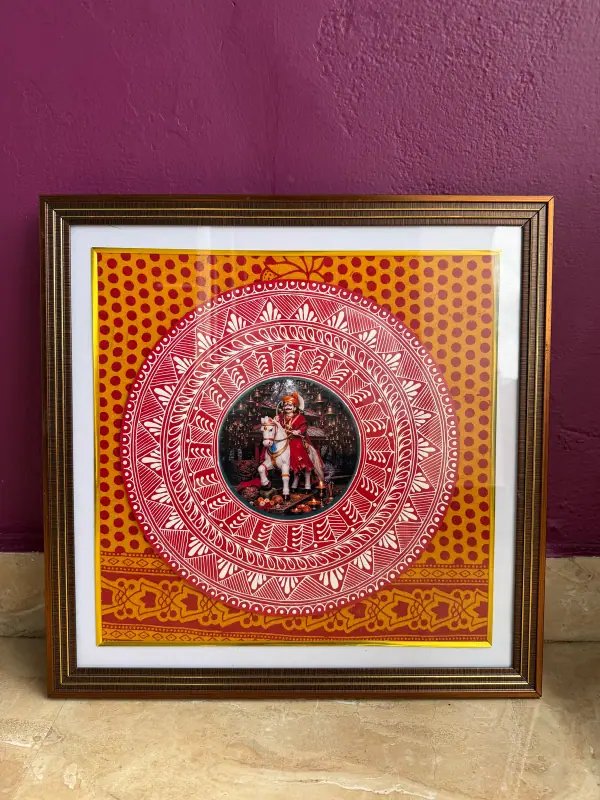
For a devotional corner
Golu Devta Aipan Frame
₹1,400
View the frame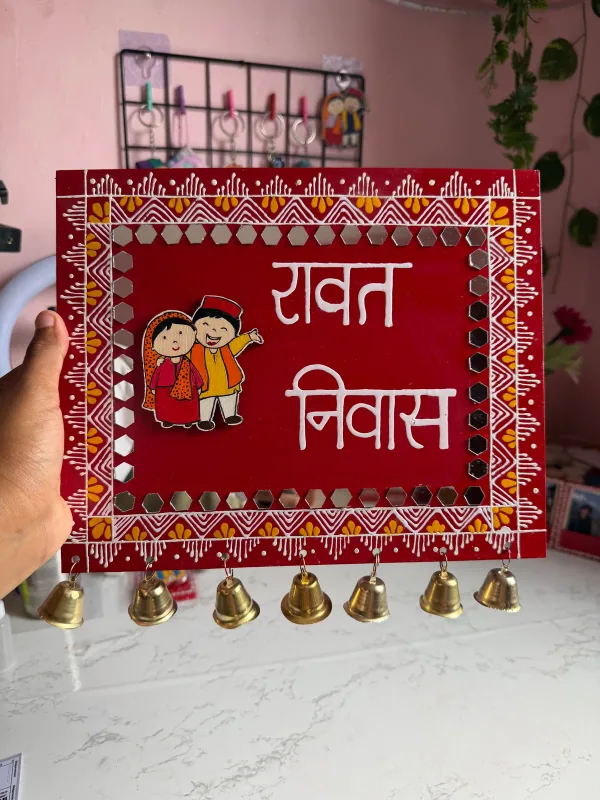
For an entrance of your own
Customised Aipan Nameplate
₹800
Explore the nameplateHave a name or a place in mind?Talk to Sneha about a piece for your home or someone you’re gifting.
Let’s make it personalLearn & choose
Questions about
Aipan art & gifts.
What is Aipan art, and which state is it from?
Aipan is a ritual folk painting tradition of Kumaon in Uttarakhand, India. Its best-known form uses white rice-paste designs on a red geru ground, especially at household entrances and places prepared for worship.[1][6]
Is Aipan the same as rangoli or alpana?
Aipan belongs to India’s wider family of floor-decoration traditions. Rangoli is often used as a broad comparison, while alpana or alpona is associated with other regional practices. Kumaoni Aipan has its own materials, names and ceremonial designs.[6]
What are geru and bisvar in Aipan painting?
Geru is the red-ochre ground; bisvar, also written biswar, is the white rice paste used for the drawing. These traditional media should not be assumed from the appearance of a modern painted product.[2][4]
Which Aipan designs are used for Diwali?
Lakshmi Chowki and Lakshmi Yantra are associated with Lakshmi puja at Diwali. Footprints, lotus forms and geometric elements occur in these designs. The arrangement depends on the practice being followed.[1][5]
Does Aipan have a GI tag?
The official GI Registry lists Uttarakhand Aipan as registered under application 648, with a certificate dated 14 September 2021. This record concerns the registered craft; it does not establish the certification of a particular shop or product.[8]
Is every Kumaoni frame an Aipan frame?
Our frame collection includes Aipan-inspired designs, Pichora backgrounds and Pahadi jewellery displays. These draw on different references to Kumaon. Read the photographs and description to understand the artwork in each piece.
Are the frames made with traditional rice paste?
Aipan-inspired frames are contemporary objects. Modern pieces may use MDF, paint and a protective finish. Check the individual listing and ask Sneha about its materials if a particular technique matters to you.
Can I personalise an Aipan-inspired gift?
Selected pieces, including the customised Aipan nameplate, offer personalisation. Share the exact spelling, preferred script, quantity and occasion date with Sneha so she can confirm the design, price and timing.
How should I look after an Aipan-inspired piece?
Care depends on the base, paint and finish. Ask for instructions for your exact piece before using water or cleaning products, or placing it in direct sun, damp conditions or outdoors. An entrance nameplate is not automatically weatherproof.